

Our process
Oily sediment treatment by bioremediation
From sediment reception through to the official threshold of 500 ppm TPH. Nine stages, controlled by an accredited laboratory and documented end to end.
- Biological process
- Environmental safety
- Regulatory compliance
Official threshold
≤500ppm TPH
Verified at stage 8 by a confirmation analysis, then attested by the batch declaration of conformity.
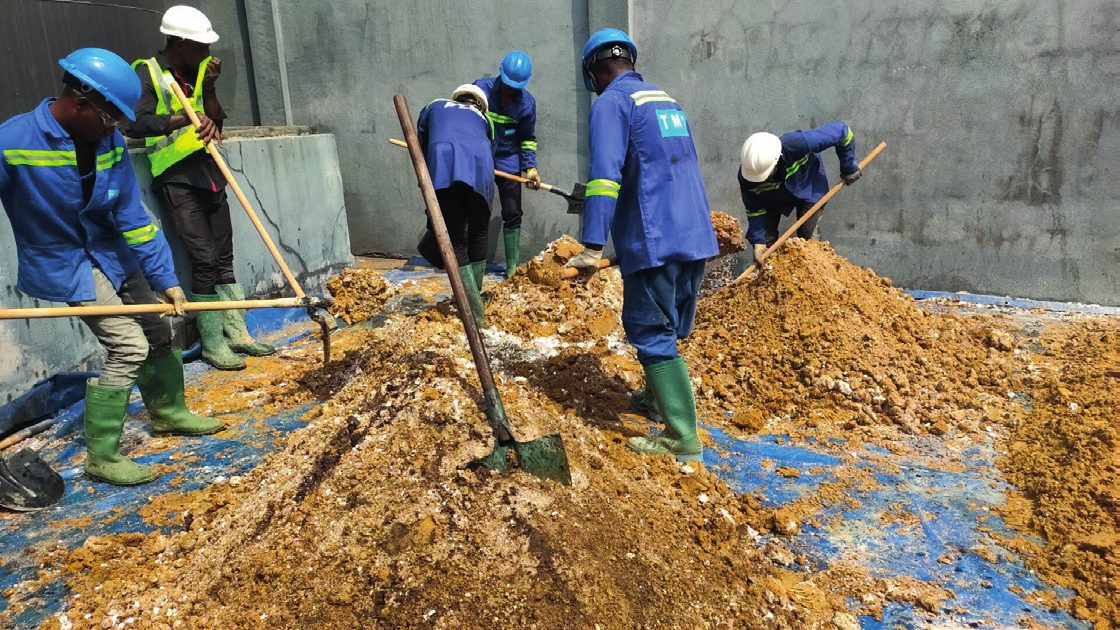
Treatment under way
The nine treatment stages
- 01
Sediment reception
Sediment reception and inspection
- Document check (transport waybill)
- Visual inspection of the sediment
- Estimation and verification of the volume received
- Routing of IBC tanks to the pre-treatment area
- Assignment of a batch traceability number
- 02
Sampling and baseline analysis
Sample collection and laboratory analysis
- Representative sampling of the batch (standardised method)
- Laboratory analysis of Total Petroleum Hydrocarbons (TPH)
- Determination of the initial concentration (ppm)
- Estimation of the total pollutant load
- Definition of the treatment strategy and dosages
- 03
Pre-treatment in IBC tanks
Biological pre-treatment in IBC tanks
Duration · 2 to 5 days
- Blending of sediment with the dedicated biological formulation (inoculum, nutrients, activating agents)
- Initiation of biodegradation and activation of the bacterial flora
- Improved bioavailability of the hydrocarbons
- Average duration of 2 to 5 days depending on nature and contamination level
- Visual monitoring of biological activation
- 04
Transfer to the treatment platform
Transfer and blending with clean soil on the platform
- Prior preparation of the platform with a selected layer of clean soil
- Unloading of the pre-treated sediment
- Initial sediment / clean soil blending
- Improved aeration and homogeneity of the mix
- 05
Active bioremediation
Turning, spreading and progressive application of biological formulations
- Uniform spreading of the material (controlled thickness)
- Regular mechanical turning to ensure oxygenation
- Progressive application of biological formulations (inoculum, nutrients, biosurfactants)
- Application frequency adjusted to analytical results and treatment progress
- Maintenance of optimal conditions (moisture, aeration, temperature) for biodegradation
- 06
Periodic monitoring and analytical control
Regular sampling and follow-up analyses
- Representative sampling at regular intervals
- TPH analyses in an accredited laboratory
- Monitoring of key parameters: moisture, oxygenation, pH, temperature
- Assessment of treatment effectiveness
- 07
Treatment adjustment
Adjustment of biological product inputs based on results
- Adjustment of dosages and application frequencies of biological products
- Adaptation of treatment conditions based on analytical results
- Continuous optimisation of the process
- 08
Final control and validation
Final control and verification that the regulatory threshold is met
- Representative final sampling
- Confirmation analysis (TPH)
- Compliant result: TPH ≤ 500 ppm
- Verification of regulatory compliance
- 09
Final report and closure
Treatment report and declaration of conformity
- Issuance of the final treatment report
- Presentation of initial and final results
- Confirmation that the regulatory threshold is met (≤ 500 ppm TPH)
- Declaration of conformity for the batch and closure of the file
The durations and frequencies shown are indicative and may vary with the nature of the sediment and the level of contamination.
What sets the process apart
- High-performance biological technology
- Specialised micro-organisms and patented products
- Proven effectiveness
- Regulatory threshold of ≤ 500 ppm TPH reached
- Environmental integrity
- Ecological and sustainable process
- Optimal adaptability
- Continuous adjustment to the nature of the sediment
- Full traceability
- Rigorous tracking at every stage of the treatment
Objective
Effective remediation of oily sediment by bioremediation, for a sustainable environment that meets regulatory requirements.